DropCatch Review 2026: Catch Rates, Fees, Auctions
When a valuable .com finishes its death march through expiry, redemption and pendingDelete, the five-day countdown ends in a race measured in milliseconds, and DropCatch wins more of those races than anyone else. It is the default answer to "how do I get a dropping domain," and mostly deserves to be. It also has quirks worth understanding before you fund an account: a public-auction model that invites the whole market to your catch, and a corporate sibling whose inventory shapes what you see on the platform. Here is the full 2026 review.
What is DropCatch and how does it work?
DropCatch is a drop-catching service: it registers deleted domains at the instant the registry releases them, on behalf of customers who placed backorders. Its edge is infrastructure. Registries throttle each registrar connection, so catching contested names is a numbers game, and DropCatch maintains more than 1,200 registrar accreditations, one of the largest arsenals in the industry (rival Gname fields 500+). When deleting .com and .net names release daily around 2:00 pm US Eastern, DropCatch fires registration attempts through that entire network in the first moments.
You interact with none of that machinery directly. You place a backorder, DropCatch schedules the attempt, and one of three things happens: the catch fails (a rival got it), the catch succeeds uncontested (the name is yours at your backorder price), or the catch succeeds with multiple backorders on file, which triggers an auction.
What does DropCatch cost?
| Item | Cost (as of mid-2026) | Notes |
|---|---|---|
| Account | Free | No membership fee to browse or place backorders |
| Backorder | $13-59 | $59 is the standard full-priority price; discounts reach the lower band |
| Uncontested catch | Your backorder price | The best-value outcome on the platform |
| Contested catch | Winning auction bid | Public auction; the backorder fee is the ticket in, not the price |
| Marketplace auctions | Bid-determined | Includes expiry stock from sibling company HugeDomains |
How good are DropCatch's catch rates really?
No catcher publishes verified per-name success rates, so honesty requires a range: industry estimates put contested catch rates at 30-50% even for the top services, DropCatch included. When a name is on every drop list with strong metrics, the NameJet/SnapNames network, Gname and smaller specialists are all firing at the same second, and somebody's infrastructure wins by luck of the millisecond. For quiet names with no other suitors, DropCatch's success rate is dramatically higher, and this is where its scale shines: an uncontested $59 catch of a decent aged name is among the best deals in domaining.
The strategic consequence: treat a DropCatch backorder as a strong probability play, not a guarantee, and for must-have names add one genuinely independent service, such as SnapNames or NameJet (never both, they share a pool), as detailed in our backorder alternatives guide.
The public auction quirk
Here is the mechanic that surprises newcomers most. When a contested catch succeeds, DropCatch runs a public auction, visible on the platform, rather than a private settlement among the original backorderers. Public means more eyes, and more eyes mean the market discovers what the name is worth, which is exactly what you did not want after quietly backordering an underpriced gem. NameJet and SnapNames take the opposite approach, restricting contested auctions to backorder holders. Neither model is strictly better: private auctions protect your research, public ones occasionally let you win names you never backordered. But know which room you are walking into, and set your ceiling before the bidding opens, because soft-close extensions punish improvisation, as our guide to how backorders work explains.
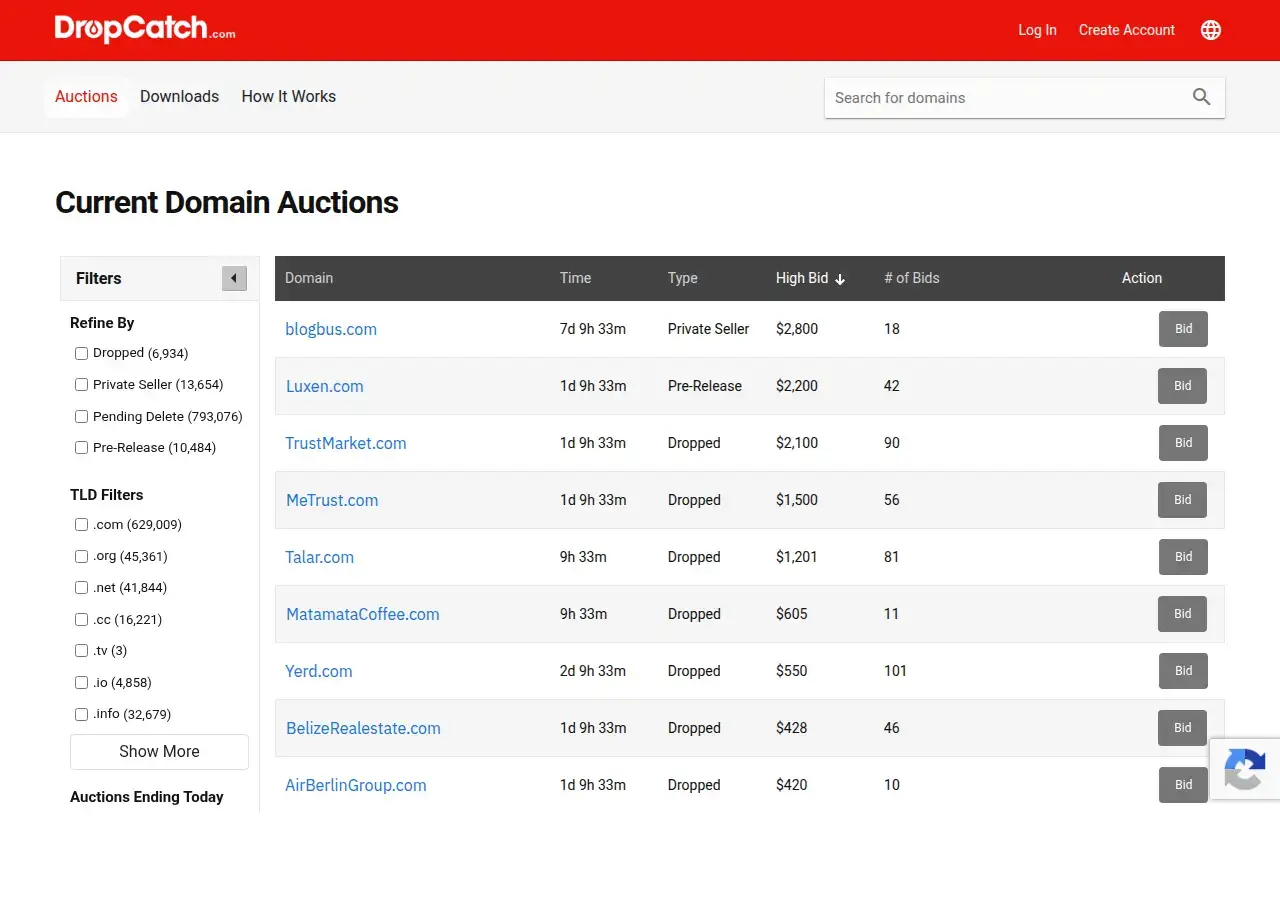
The public auction board at DropCatch, captured August 2026
The HugeDomains relationship
DropCatch is a sibling company of HugeDomains, one of the largest domain retailers, and HugeDomains expiry stock flows into DropCatch's auction listings. The practical takeaways: some inventory on the platform arrives with retail-shaped pricing expectations rather than drop-market pricing, and names DropCatch catches without a customer backorder do not simply evaporate; the corporate family has its own channels for them. None of this is hidden or improper, but bid accordingly: a listing's provenance affects what counts as a fair price.
A working DropCatch routine
The buyers who get consistent value out of the platform treat it as the last step of a pipeline, not a browsing destination. A repeatable weekly loop looks like this: pull the coming week's pending-delete lists and filter hard on metrics; verify each survivor's EPP status actually reads pendingDelete, since anything still in grace may sell at a registrar expiry auction and never drop; check backlinks, anchors and Wayback history until the shortlist is names you would happily own at auction prices, not just at $59; place the backorders before the final day, with a written ceiling next to each name; and when a contested catch triggers a public auction, bid your ceiling through the proxy system and close the tab. The names you lose to bigger budgets were never yours at a profitable price.
Verdict: should you use DropCatch in 2026?
Yes, for its core job. For public .com drops it is the first backorder to place: biggest network, free account, $13-59 entry, clean interface. Budget for the public-auction outcome on anything with visible metrics, and do your valuation before the catch, not during the auction adrenaline. Research is the step DropCatch does not do for you: pending-delete lists with metrics attached, from a paid aggregator such as DomCop (plans from roughly $68 per month, 2-day money-back guarantee, no free trial) or free and manual via ExpiredDomains.net, tell you which names deserve the backorder in the first place. For how DropCatch stacks up against the biggest expiry-stream venue, see GoDaddy Auctions vs DropCatch.
Frequently asked questions
Is DropCatch free to join?
Yes. Creating an account costs nothing; you pay per backorder, $13-59, with $59 the standard full-priority price. Contested catches add the auction price on top of entry.
What happens if several people backorder the same domain?
If DropCatch wins the catch, the name goes to a public auction on the platform rather than a private one among backorderers. Expect real competition on any name with obvious metrics, and set your maximum before it starts.
Does a domain caught at DropCatch keep its age?
No. A catch is a brand-new registration of a deleted name, so WHOIS age resets to zero. The backlink profile and archived history survive, since they belong to the name, not the registration. Only expiry-auction wins preserve the original registration.
What if DropCatch misses the catch?
The name went to a rival's customer or the open market, and your backorder simply did not convert. Like most catchers, DropCatch charges on success, though you should confirm current payment terms at checkout. Losses are part of the game even at 1,200+ accreditations.
Does DropCatch cover TLDs beyond .com?
Its firepower is built around the daily .com and .net drop, where the 2:00 pm Eastern release rewards raw registrar connections. For ccTLDs with their own release mechanics, specialists usually make more sense, such as park.io for .io, .ly and .sh at $99 per catch.