Park.io Review: The $99 Backorder for .io and Hacker TLDs
Nearly every drop-catching service was built around .com, where the daily deletion cycle is an industrial event with industrial competition. park.io went the other way. Since the mid-2010s it has specialized in the country-code TLDs that developers and startups actually chase, with .io at the center, and for most of that time it has been the default answer to one specific question: how do you catch a dropping .io name? This review covers how the flat $99 model works, what changed in the .io landscape once Identity Digital took over the registry backend, and when a different route now makes more sense.
What is park.io, and who is behind it?
park.io is a drop-catching service for hacker TLDs: .io, .ly, .sh and a set of similar country-code extensions that punch far above their populations because software people like them. It began around 2014 as a side project by Mike Carson, a developer who noticed that dropping .io names had no serious catching infrastructure and wrote his own scripts to register them the moment they became available. The scripts became a service, the service became the standard channel for hacker-TLD drops, and the core model has barely changed since: place a backorder for free, pay $99 only if park.io secures the name, and settle contested catches in a public auction. In an industry that loves feature sprawl, park.io has stayed a deliberately narrow tool.
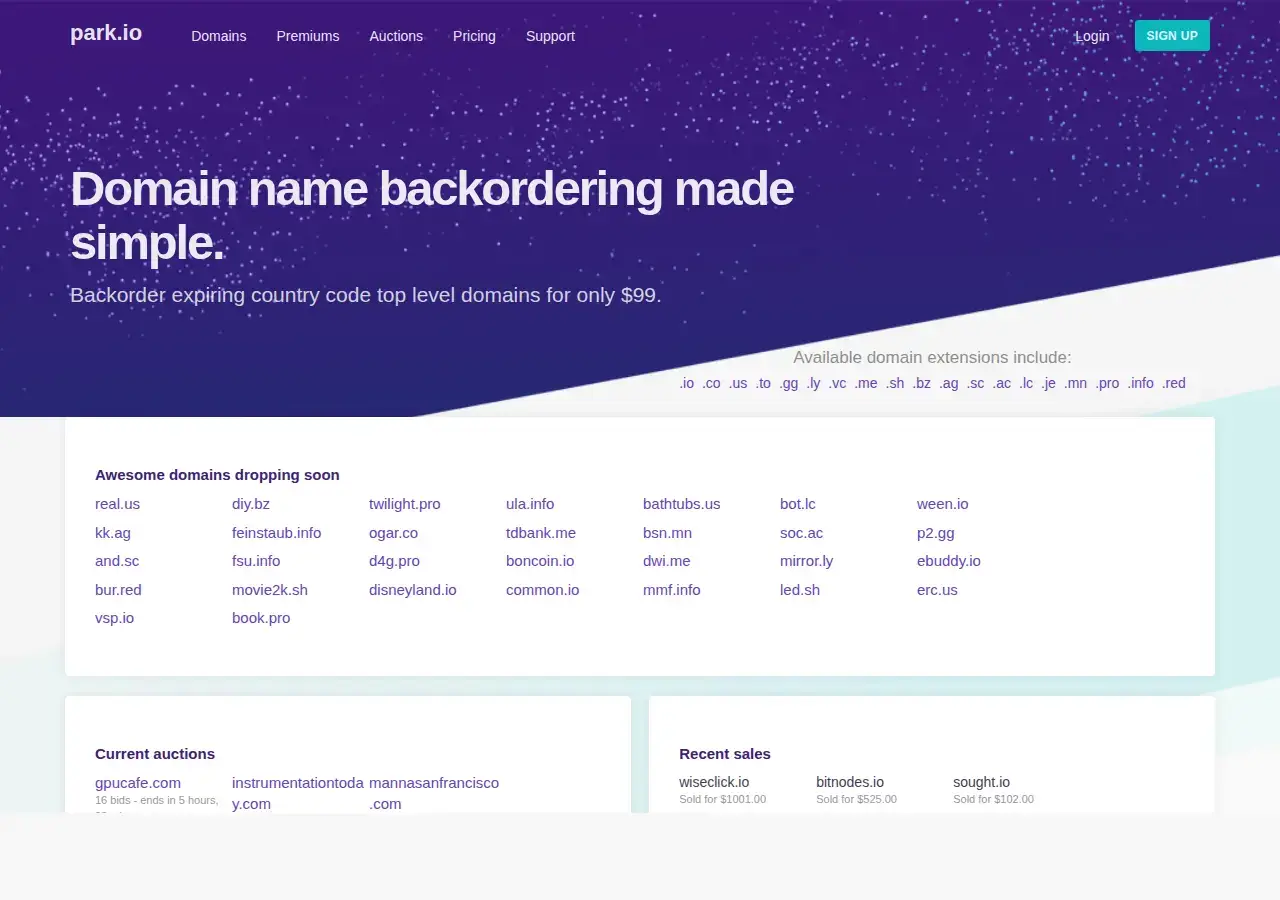
The park.io homepage, captured August 2026
How does the $99 backorder actually work?
Three properties define the product, and all three are unusual. First, placing an order costs nothing: you can backorder a name and simply never be charged if the catch fails, which makes speculative orders painless. Second, pricing is flat at $99 per caught domain, whether the name is a forgettable four-worder or a one-word brandable; there is no appraisal-based pricing and no premium tier. Third, contention is resolved in the open: when more than one park.io user has backordered the same name, the catch goes to a 10-day public auction rather than a private allocation, and the winner pays the final auction price instead of the flat fee.
What you receive is a brand-new registration. park.io registers the name at the instant the registry releases it, which means the WHOIS record starts fresh on catch day. The backlink profile, Wayback Machine history and type-in traffic all survive, because they belong to the name rather than the registration, but the original creation date does not carry over the way it would if you had won a registrar expiry auction. Buyers who specifically need continuous registration history should be hunting the expiry stream instead, a distinction covered in our expiry vs drop explainer.
park.io at a glance
| Feature | How park.io handles it |
|---|---|
| Backorder price | $99 flat per domain, no tiers, no appraisal pricing |
| When you pay | Only on a successful catch; placing the order is free |
| TLD focus | .io, .ly, .sh and similar hacker ccTLDs |
| Contested catches | 10-day public auction; winner pays the auction price |
| Membership | Free account, no subscription required |
| What you receive | A new registration; WHOIS age resets, backlinks and archives survive |
Is park.io still the best way to catch .io?
The honest answer as of mid-2026: still the specialist, no longer the only serious player. For years .io ran on niche registry infrastructure that mainstream .com catchers largely ignored, which is precisely the gap park.io filled. Today .io sits on Identity Digital's registry backend, its deletions flow through a conventional lifecycle, and general drop catchers and backorder aggregators increasingly list dropping .io names alongside their .com inventory. The registry side has learned to keep value for itself too: held-back premium .io names were auctioned through GoDaddy in June 2025 rather than being released for anyone to catch. The result is more competition on the best names from both directions, catchers below and the registry above.
Demand has not softened either. Roughly 18% of Y Combinator startups use a .io address, and that startup association is exactly what keeps resale interest in short, product-ready .io names steady. Plan around the base rates: even top catching services land an estimated 30-50% of the contested names they chase, so a park.io backorder on a good name is a strong lottery ticket, not a guarantee, and the 10-day auction that follows a contested catch can price the name well beyond $99.
Strengths and weaknesses
- Strength: pay-on-catch billing. No prepayment, no credit balances, no refund tickets for missed catches. You are charged when you get the name, and otherwise never.
- Strength: flat, predictable pricing. $99 is $99 whatever the name. Compare backorder pricing elsewhere, $13-59 at DropCatch and $69-79 minimums at NameJet/SnapNames for different inventory pools, in our fee comparison table.
- Strength: transparent contention. A public 10-day auction among interested buyers is fairer than an opaque allocation, and losing bidders pay nothing.
- Weakness: no .ai. Expired .ai names never free-drop; they route through official Namecheap daily auctions, with the registry DropZone behind them. No catcher, park.io included, can grab a dropping .ai.
- Weakness: auctions erase the bargain on obvious names. The $99 headline applies to uncontested catches; anything visibly good tends to attract multiple backorders and auction pricing.
- Weakness: age resets. As with every drop catch, the registration record starts over, which matters for buyers who care about continuous domain history.
How should park.io fit your workflow?
Treat it as the specialist arm of a broader routine. Research comes first: a $99 trigger deserves a real vetting pass, so check the Wayback history, the anchor-text profile and cross-checked metrics before ordering, since authority tools disagree by about 26 points on average for the same site. Aggregated research platforms such as DomCop (paid, from roughly $68 per month, no free trial, 2-day money-back guarantee) list dropping domains across TLDs with Majestic and Moz data attached, and ExpiredDomains.net covers 676 TLDs free if you prefer manual checks. Then place the backorder with time to spare, decide your auction ceiling before any 10-day auction starts, and spread genuinely independent attempts on must-have names, the multi-service logic from our backorder guide. For .com drops, park.io is the wrong tool; that market belongs to the high-volume catchers.
Frequently asked questions
Does park.io handle .ai domains?
No, and neither does any other catcher. Expired .ai names never reach public deletion; since February 2025 they flow through official Namecheap daily auctions, with the registry DropZone handling unsold names. For .ai, bid in those auctions instead of backordering.
What happens if park.io misses my name?
You pay nothing. Pay-on-catch means a missed catch costs only the time you spent researching. Misses happen even for specialists, since a rival service, the registry or a renewing owner can all take the name off the table.
Do park.io catches keep the domain's age?
No. A catch is a new registration, so the WHOIS creation date resets to catch day. Backlinks, archived history and traffic survive, because they attach to the name itself rather than the registration record.
Why does park.io cost $99 when DropCatch starts at $13?
Different pools, different infrastructure. DropCatch prices high-volume .com catching backed by 1,200+ registrar accreditations, while park.io runs specialist tooling for ccTLD registries with their own release quirks. The flat fee also buys pay-on-catch billing, which most cheaper services do not offer.